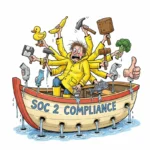

Everything looks good until the prospect’s legal team sends over their vendor questionnaire with “SOC 2 Type II preferred” buried in the security requirements. Cue the panic googling: “What’s the difference between Type I and Type II“, and “do we really need the more expensive one?“
This confusion isn’t unusual and things can be confusing especially if you are reading things about SOC 1 (controls over financial reporting relevant to user entities), and it’s own Type I and Type 2 Reporting or even what a SOC 3 (general use version of a SOC 2 Report) is. You can find more information on the differences on these reports on the AICPA website.
Many growing companies offering services through the internet hear they need SOC 2 compliance to win enterprise deals, but the distinction between Type I and Type II reports often gets lost in the security and compliance alphabet soup. If you’re trying to figure out which type of report makes sense for your company right now, this guide will help you understand the key differences between the Type I Report and the Type II Report to help you make the right choice for your stage and goals.
What is SOC 2?
The American Institute of Certified Public Accountants (AICPA) introduced the framework used for System and Organization Controls (SOC) Reports. It has evolved over time, formerly known as SAS 70. A SOC 2 Report is an attestation framework designed for service organizations whose services could impact their clients’ operations, compliance, or data security. The framework focuses on criteria that an organization must meet and its applicability against relevant trust service categories: Security (Commonly required for all SOC 2 reports), plus any applicable areas: Availability, Processing Integrity, Confidentiality, and Privacy (applied based on your specific services and commitments to clients). The SOC 2 Report is meant to demonstrate that your system has a compliance posture that was assessed via an independent auditor’s assessment conducted under SSAE 18 professional standards (and subsequent amendment SSAEs applicable to AT-C section 105 and AT-C section 205).
Whether you directly handle customer data, process information without accessing it, provide infrastructure that affects client system availability, or deliver services that impact processing integrity, a SOC 2 Report is a tool that is used by Third Party Risk Management (TPRM) teams and other decision makers to view how a system is managed and it’s a tool to help these stakeholders, like prospective or existing clients, gain trust that internal controls operate effectively based on the framework criteria. Enterprise clients, regulators, and business partners increasingly use TPRM to require compliance reports, such as a SOC 2 Reports before they’ll trust you with their data. Read more on what a SOC 2 is all about.
SOC 2 Report Types
SOC 2 comes in exactly two report types: Type I (you will also see it written “SOC 2 Type 1”) evaluates whether your controls are suitably designed as of a single date, and Type II (“SOC 2 Type 2”) evaluates that design plus whether the controls operated effectively over a review period. There is no Type III; every SOC 2 engagement produces one of these two reports.
SOC 1 and SOC 3 sometimes get lumped in as “SOC 2 report types,” but they are different reports altogether: SOC 1 covers controls relevant to your clients’ financial reporting, and SOC 3 is the public, general-use companion to a SOC 2 Type II. Not sure which report your customers actually need from you? Our “Do I need SOC 2?” assessment narrows it down in about two minutes.
SOC 2 Type I Explained
Think of SOC 2 Type I as a snapshot in time. It’s a point in time test. It looks at if you have the policy and a process in place and the auditor performs some audit procedures to understand the process while noting its designed to work correctly and is able to work assuming you are doing the things you say you do… they just aren’t putting the opinion that it is working effectively throughout the course of a testing window. The report uses an “as of” date. It’s simply, the auditor looking if your organization has the tools and processes in place by nature of its design.
What Type I covers:
- The suitability of control design at a specific date to provide reasonable assurance that your service commitments and system requirements would be achieved
- Whether those controls are appropriately designed to meet the relevant Trust Services Categories and Criteria
- Documentation that your policies and procedures exist and make sense on paper
- Management’s description of your service organization’s system as of a specified date
Typical use cases:
- Early-stage companies that need to show compliance intent quickly
- Organizations building their compliance foundation for the first time
- Companies with tight timelines who need something faster than a full Type II
- Organizations that have recently implemented new controls and need to demonstrate proper design before building operational history
The upside: If you are ready and have the time it takes budgeted internally to work with a qualified independent auditor, the Type I report is faster to complete (often 6-8 weeks), less costly, and still demonstrate to enterprise partners that you’re serious about security. For many early-stage deals, showing you have SOC 2 Type I can be enough to get through vendor security reviews.
The limitation: Type I doesn’t validate that your controls actually operated effectively over time. It’s proof of design adequacy, not proof of operational execution. The client may not be satified with just the Type 1 and will obviously ask you next, “what are your plans for Type 2 and when will that be available to them.”
SOC 2 Type II Explained
SOC 2 Type II is where things feel more “audit-like”. The guidance references the Type II as needing to show operational effectiveness in addition to the design covered in the Type I. This is what most folks thing of as it comes to a “traditional audit”. Auditors will do sampling procedures and may want to observe controls working (eg. show me your door badge system works; Provide us the new hire details for X,Y,Z employees showing they were hired following your outlined processes). Thus we get a report testing both design of your controls and their operating effectiveness throughout the specified period. Your independent auditor will sample and test controls, as appropriate and where applicable, to gain an understanding of how the processes in place are working throughout the report examination period. The AICPA guidance does not prescribe a minimum reporting period, however, the independent service auditor uses professional judgment to determine if sufficient appropriate evidence can be obtained to support an opinion regarding control effectiveness. The auditor will need to be comfortable as will you, to have a period that shows your operations and controls work effectively, to do this, you need data points, what I mean by data points? Processing activity around your controls (new hires/change tickets etc). Generally, it is seen as a best practice to have at least a minimum of 6 months in a Type 2 Report. This is something you would need to discuss with your auditor and even the client(s) that are driving this work.
What Type II covers:
- Everything from Type I (control design and suitability)
- Expect to have population requests for things like change management / SDLC process events. Auditors will want to sample activities around logical access and any change management
- Evidence that controls operated effectively throughout the entire reporting period, that you define
- Detailed testing results showing your security measures worked consistently, not just on paper
- Documentation of any exceptions or control failures, plus how you addressed them;
- Assessment of whether service commitments and system requirements were actually achieved based on the Trust Services Criteria
Typical use cases:
- Organizations where clients specifically require Type II (increasingly common)
- Companies that want to demonstrate mature, battle-tested security operations
- Service organizations needing to show consistent operational effectiveness over time
- Growth-stage and mature companies engaging with large enterprise customers
The upside: Type II provides much stronger assurance by demonstrating operational effectiveness. Your auditor is testing through a period with a start and end date (examination period). It tells your clients and prospects you didn’t just design good controls, you operated them successfully throughout the examination period. This carries significantly more weight in enterprise sales cycles and investor due diligence.
The limitations: Type II requires more time (often 6 months+ for the audit examination period, not including any testing or quality assurance time the auditor needs). You need your controls to be operating effectively before the that audit period begins, which means more upfront preparation and operational maturity.
The Fundamental Difference
Type I provides an opinion that “controls are suitably designed to achieve service commitments and system requirements,” it’s a snapshot with an “as of” date. While Type II provides an opinion that “controls are suitably designed AND operated effectively to achieve service commitments and system requirements throughout the specified period.” For an auditor to test operational effectiveness, this typically involves the audit sampling evidence from your teams over the report period to determine if controls are working appropriately.

Key Differences at a Glance
| Aspect | SOC 2 Type I | SOC 2 Type II |
|---|---|---|
| Focus | Controls design suitability | Controls design and operating effectiveness |
| Timeframe | Single point in time (as of date) | Over Specified Period (auditor determines sufficient evidence period) |
| Service Auditor Opinion | Design suitability only | Design suitability and operating effectiveness |
| Effort Required | Lower (eg. a test of one) | Higher |
| Timeline | 6-8 weeks | Variable based on period and examination timeframe; Most common is 12 months; |
| Value to Customers | Early validation, “we’re on the path” | Deeper trust, enterprise-ready |
| Common Stage | New to compliance journey eg. See funding / Series A round | Series B and beyond; Established service providers obtain the report annually. |
| Cost | Lower | Higher |
| Operational Evidence Required | Minimal | Extensive (throughout period) |
| Operational Maturity Required | Controls implemented and documented | Controls operating effectively throughout period |

How to Decide Which Report You Need
The decision often comes down to three practical factors:
What your clients actually demand. Some enterprise prospects will accept Type I, especially if you’re early-stage and building the relationship. It also means you are in-route to Type 2. Others have moved to requiring Type 2 across the board. You may think they may not want to wait for a Type 1, BUT, Type 1 is designed to be the first step in getting towards a Type 2. Ask your sales team to understand what the customers want and ask your internal teams on what they’re hearing in security reviews.
Your operational maturity. Type II requires that your controls have been operating effectively for the entire examination period. It is considered risky to move to a Type II if you haven’t obtained a Type I and are not familiar with the framework. If you’ve recently implemented new controls or made significant changes, you may need to build operational history with a Type I first.
Timeline and budget reality. Type I can often be completed in 6-8 weeks if your controls are already documented and operational. Type II requires a period determined by the auditor’s professional judgment to obtain sufficient evidence of operating effectiveness, plus the examination time itself. Factor in your team’s bandwidth and cash flow considerations. A first year audit can take your internal teams anywhere from 100-320 additional hours to become ready. Sometimes it depends on the industry and rigor of controls you may need. Keep in mind after obtaining a Type 1 status, it’s an annual activity afterwards and can take teams another 80-100 hours per eyar working with auditors and collecting evidence.
General guidance: For companies starting their compliance journey, it’s common to see a readiness assessment followed with a SOC 2 Type I engagement. Then the transition to Type II beginning after the successful Type I assessment. Many companies use Type I as a stepping stone, building operational evidence while demonstrating initial compliance commitment following the Type I engagement. Talk with your SOC auditor to determine what period testing would work best for the Type II Report.
SOC 1 Type 1 vs SOC 1 Type 2: Same Idea, Different Report
The Type 1 / Type 2 distinction is not unique to SOC 2. SOC 1 reports use it too, and it means the same thing. A SOC 1 Type 1 report evaluates whether controls relevant to your clients’ financial reporting (think payroll processors, billing platforms, transaction processors) are suitably designed as of a point in time. Similar to a SOC 2 Type 2, a SOC 1 Type 2 adds testing of operating effectiveness across a review period.
What separates SOC 1 from SOC 2 is the subject matter, not the type mechanics: SOC 1 addresses internal control over financial reporting (ICFR), while SOC 2 addresses the Trust Services Categories covered in this post. If your service could affect how your clients’ auditors view their financial statements, SOC 1 is the conversation to have. Our SOC 1 reporting page covers when it applies.
SOC 1 vs SOC 2: What Is the Same
Before the differences, the overlap, because it is larger than most comparison articles let on. Both SOC 1 and SOC 2 are attestation reports issued by a licensed CPA firm under the AICPA’s attestation standards (SSAE No. 18; AT-C section 320 for SOC 1, AT-C section 205 for SOC 2). Both come as a Type 1 (design of controls as of a date) or a Type 2 (design and operating effectiveness across a period). Both contain management’s assertion, the auditor’s opinion, a description of the system, and, in a Type 2, the tests of controls and their results. Both are restricted-use reports meant for the people who rely on your controls, both name Complementary User Entity Controls your customers have to run on their side, and both treat subservice organizations the same way, carved out or included. Neither is a certification, and neither has a pass or fail score.
What is the difference between a SOC 1 and a SOC 2 audit?
A SOC 1 audit examines the controls at a service organization that affect its clients’ financial reporting, measured against control objectives management defines, while a SOC 2 audit examines controls over the security, availability, processing integrity, confidentiality, and privacy of a system, measured against the AICPA’s Trust Services Criteria.
The readers differ with the subject. A SOC 1 is written for your clients’ financial statement auditors, who need to know whether your payroll run, claims processing, or fund administration could put a misstatement into their client’s books. A SOC 2 is written for your customers’ security and vendor-risk teams, who need to know whether the system that holds their data is protected. Same auditor, same standards, different question.
How to Choose: SOC 1, SOC 2, Type 1, or Type 2
Most of the confusion clears up once you separate the two decisions. The first is subject matter (SOC 1, SOC 2, or both), and it is decided by who is asking and what they rely on you for. The second is timing (Type 1 or Type 2), and it is decided by how long your controls have been operating and what your customers will accept.
| Your situation | Report | Why |
|---|---|---|
| Your clients’ financial auditors ask about your controls (payroll, claims, loan servicing, fund administration, benefits) | SOC 1 | Your service touches their financial statements, so their auditors need assurance relevant to internal control over financial reporting |
| Enterprise customers’ security teams send questionnaires; you host, process, or transmit their data | SOC 2 | The Trust Services Criteria answer the security-review questions those teams are asking |
| Both of the above (a payments platform, a fintech, a TPA with a SaaS product) | SOC 1 and SOC 2 | Different readers and different criteria; one firm can run both examinations and reuse the overlapping evidence |
| First report, a deal waiting on proof, controls implemented recently | Type 1 first | Design as of a date is the fastest formal report to issue, and the observation window for the Type 2 can start the same day |
| Customers ask for operating evidence; a renewal; controls have run for months | Type 2 | Operating effectiveness across a period is what enterprise buyers ultimately require, renewed annually |
| You want a public-facing summary for a trust page or marketing (SOC 2 only) | SOC 3 alongside the SOC 2 Type 2 | A general-use report issued from the same examination |
SOC 2 vs ISO 27001
ISO 27001 comes up in almost every SOC 2 conversation, usually because a prospect abroad asked for it. The two overlap heavily on the controls and differ almost entirely on the mechanics.
| SOC 2 | ISO/IEC 27001 | |
|---|---|---|
| What it is | An attestation report with an auditor’s opinion | A certification against a management-system standard |
| Who issues it | A licensed CPA firm under AICPA attestation standards | An accredited certification body |
| Measured against | The Trust Services Criteria (Security always; the other four categories as scoped) | The ISMS requirements in clauses 4 to 10, plus the Annex A control set |
| What you receive | A detailed restricted-use report (Type 1 or Type 2) | A certificate, with the detailed audit findings kept internal |
| Cadence | Annual, most often a rolling 12-month Type 2 | A three-year certificate with annual surveillance audits |
| Where it lands | North American enterprise buyers, SaaS procurement, US vendor-risk teams | International tenders, EU and APAC procurement, regulated sectors abroad |
If your buyers are North American, SOC 2 first. If a meaningful share of revenue is international, or a specific contract names ISO 27001, plan for both and build one control set that feeds both, since most of the Annex A controls map cleanly onto the Trust Services Criteria. What one cannot substitute for the other is the reader: a US vendor-risk team will still ask for the SOC 2 report even if you hand them a certificate.
What Each Report Costs and How Long It Takes
Timelines are more predictable than most people expect, because the AICPA’s requirements pin most of the shape:
- Readiness assessment (optional, first-timers): 4 to 8 weeks, plus whatever remediation it turns up before the audit period starts.
- SOC 2 Type 1: roughly 1 to 2 months from kickoff to issued report, assuming the controls are in place.
- SOC 2 Type 2: the observation window, typically 6 to 12 months (a first window can be as short as 3), then a draft report about two weeks after fieldwork and the final within 5 to 7 weeks of period end.
- SOC 1 Type 1: about 4 to 6 weeks from scoping to report; SOC 1 Type 2: a 6 to 12 month period plus roughly 6 to 8 weeks for fieldwork and reporting.
Cost moves on the same handful of drivers for every report type: how many systems sit inside the boundary and how complex they are, how many controls are in scope, which Trust Services Categories (SOC 2) or control objectives (SOC 1) you include, how mature your evidence already is, and whether you package readiness, Type 1, and Type 2 into one engagement, which is how most first-time teams buy it. SOC 1 swings more than SOC 2 because the control objectives are custom and there is user-auditor coordination on top. For a number that fits your environment rather than a market range, use the SOC 2 audit pricing calculator or ask for a fixed-fee quote before any work begins.
SOC 1 Type 2 vs SOC 2 Type 2
These two get compared constantly because they look alike from the outside: both are period reports, both carry an opinion on operating effectiveness, both include tests of controls. From the auditor’s chair they are different engagements.
| SOC 1 Type 2 | SOC 2 Type 2 | |
|---|---|---|
| Subject matter | Controls relevant to your clients’ internal control over financial reporting | Controls over the security, availability, processing integrity, confidentiality, and privacy of a system |
| Who sets the criteria | Management defines the control objectives; the auditor evaluates whether they are reasonable | The AICPA defines the Trust Services Criteria; management maps its controls to them |
| Who reads it | Your clients and their financial statement auditors (user auditors) | Your customers’ security, vendor-risk, and procurement teams |
| Where testing concentrates | Transaction processing, reconciliations, calculations, change management over financial applications, restricted access to financial data | Access control, change management, risk assessment, monitoring, incident response, vendor management, plus any category-specific controls |
| Complementary User Entity Controls | Named, and heavily relied on by user auditors | Named, and reviewed by customers during onboarding |
| Period and opinion | A defined period; opinion on design and operating effectiveness | A defined period; opinion on design and operating effectiveness |
Organizations that need both usually run the two observation windows concurrently and let one evidence request serve both, since access reviews, change tickets, and vendor reviews sit in both scopes. The reports stay separate, because the readers are, but the work does not have to be done twice.
The Bottom Line
Both report types provide valuable assurance under AICPA professional standards. But Type II has become the standard for companies serious about enterprise relationships, the stronger operational assurance it provides often translates directly into faster sales cycles and higher deal values.
Think of Type I as validating your foundation and Type II as proving you can maintain it over time. Start planning early, the preparation work for either report takes time, and Type II evidence doesn’t start accumulating until your controls are running effectively.
Neither report results in a “pass/fail” verdict. These are assurance reports where a service auditor provides professional opinions on control design and, for Type II, operating effectiveness.
Frequently Asked Questions
What is the difference between SOC 2 Type 1 and Type 2?
A SOC 2 Type 1 report assesses whether your controls are suitably designed at a single point in time, an “as of” date. A SOC 2 Type 2 report covers that design plus operating effectiveness: the auditor tests whether the controls actually worked throughout a review period. Type 2 is the stronger level of assurance and the one most enterprise customers ask for.
Which comes first, Type 1 or Type 2?
The typical path is a readiness assessment, then a Type 1 to validate control design, then the Type 2 review period begins. The Type 1 acts as a checkpoint: it confirms your controls are designed properly before you spend months accumulating operating evidence against them.
Do I need a Type 1 before a Type 2?
No. There is no AICPA requirement to complete a Type 1 first. It is a risk decision: starting with a Type 1 is recommended when controls are newly implemented, because it surfaces design gaps before they can become exceptions across a full Type 2 period. Organizations whose controls have already been operating for months sometimes go straight to a Type 2.
How long does a SOC 2 Type 2 audit take?
Plan for the review period plus the examination itself. Review periods commonly run 3 to 12 months: first-time reports often use a shorter 3-to-6-month period, while established programs report on 12-month cycles, and the auditor’s testing and reporting adds several weeks after the period closes. End to end, a first Type 2 including preparation typically spans 6 to 12 months.

At Sage Audits, We Work With You
We know audits can be overwhelming. Our goal is to make the process smoother, more understandable, and less stressful. We stand beside you with practical guidance, not just paperwork.
Whether it’s your first SOC 2 or a renewal, we’re here to help you get through it confidently and with real value. – Jordan Novak, Managing Partner